
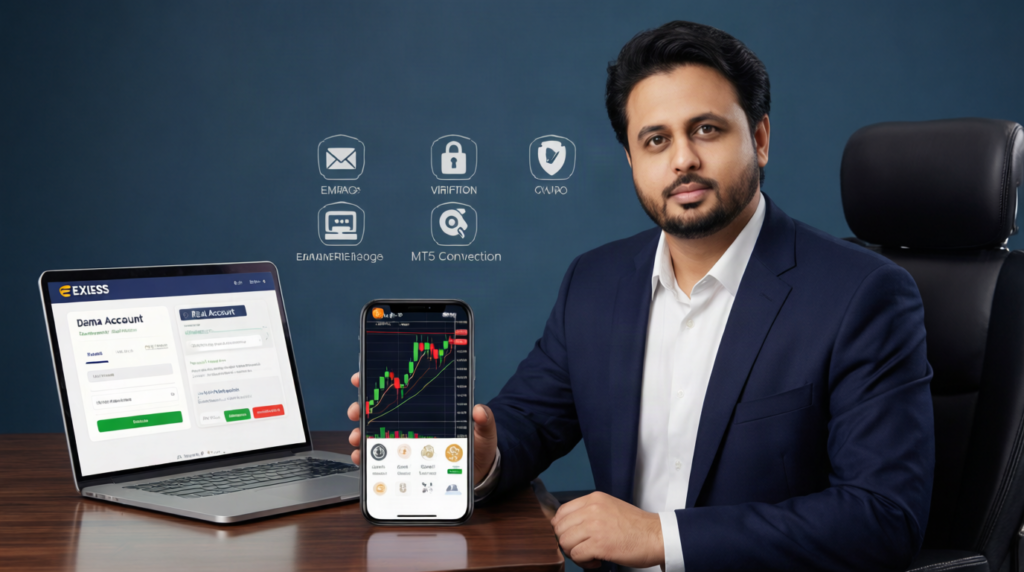
Understanding the difference between a Forex demo vs real account in Exness Broker is essential before you risk actual money. Although both account types may provide access to charts, trading instruments and order-placement features, they are not psychologically or financially identical.
An Exness demo account uses virtual funds. It allows beginners to learn the platform, place orders, test indicators and practise risk management without losing real money. An Exness real account, on the other hand, contains actual deposited funds. Every spread, commission, profit, loss and trading decision can affect your capital.
According to the official Exness real and demo account guide, real accounts use real funds while demo accounts use virtual funds. This simple difference changes the entire trading experience.
A demo account can help you understand how trading works, but profitable demo performance does not guarantee success on a live account. Fear, greed, slippage, changing liquidity and real financial consequences can influence decisions once actual money is involved.
This complete guide compares Exness demo and real accounts, explains their advantages and limitations, and helps beginners decide when—or whether—they should consider moving from virtual practice to live trading.
Important notice for Pakistani readers: Exness is an offshore Forex and CFD provider. The State Bank of Pakistan states that remitting foreign exchange to overseas Forex, margin-trading and CFD platforms is not allowed without applicable SBP permission. A foreign regulatory licence does not automatically establish authorization in Pakistan. Verify the latest legal and regulatory position independently before opening or funding any real account.
What Is an Exness Demo Account?
An Exness demo account is a simulated trading account funded with virtual money. It is primarily designed for learning, platform practice and strategy testing.
No real deposit is required to place demo trades, and any demo profit cannot be withdrawn because it is not real money. Similarly, demo losses do not affect your personal funds.
According to the official Exness demo-account page, a newly registered user generally receives an MT5-based demo account containing $10,000 in virtual funds by default. Platform features, availability and initial virtual balances can change, so users should confirm current details directly inside their Exness Personal Area.
A demo account may be used to practise:
- Opening buy and sell orders
- Setting stop-loss and take-profit levels
- Using market and pending orders
- Understanding spreads and price movement
- Testing indicators and Expert Advisors
- Comparing different timeframes
- Calculating lot sizes
- Applying risk-to-reward rules
- Keeping a trading journal
- Evaluating a strategy over multiple trades
Beginners can watch the practical tutorial about how to create a demo and real account and use a trading platform before practising.
How an Exness Demo Account Works
A demo account connects to a simulated trading environment. Price movements are designed to resemble live-market conditions, while profits and losses are calculated using virtual funds.
Exness states that demo trading conditions are intended to reflect real-account conditions. However, a simulation cannot fully reproduce the emotional pressure and every execution circumstance of live trading.
You may be able to select settings such as:
- Trading platform
- Account type
- Account currency
- Maximum leverage
- Virtual balance
- Trading password
- Account nickname
Exness currently offers demo versions for its main account types, except Standard Cent, according to its account-creation documentation. Availability may vary by jurisdiction and can change.
Main Advantages of an Exness Demo Account
The most important advantage is that it allows you to practise without risking real capital.
Other benefits include:
- Free platform practice
- No real trading loss
- Strategy back-testing and forward-testing
- Familiarity with MT4, MT5 or available Exness platforms
- Practice with different instruments
- Experience placing and modifying orders
- Opportunity to test risk-management rules
- Ability to identify technical mistakes
- Suitable environment for beginners
- Useful testing space for experienced traders
A demo account is also valuable when testing a new strategy, indicator or Expert Advisor. Even experienced traders may return to demo trading before applying a major change to a live strategy.
Limitations of a Demo Account
Demo trading has several important limitations:
- The virtual balance may be much larger than the amount you could actually deposit.
- Losing virtual money does not create the same emotional pressure as losing real money.
- Traders may take unrealistic risks because there is no financial consequence.
- Demo profitability cannot be withdrawn.
- Live execution may be affected by slippage, liquidity and market volatility.
- Demo success does not prove that a strategy will remain profitable.
- Traders may ignore discipline because the account can be replenished.
- A demo account may be deleted after a period of inactivity.
Exness explains that demo accounts may be permanently deleted following inactivity, while inactive real accounts may instead be archived and later reactivated.
What Is an Exness Real Account?
An Exness real account—also called a live account—is a trading account that uses actual funds. The trader deposits money, places real market orders and becomes financially responsible for each result.
Profitable trades may increase the account balance, while losing trades reduce it. Deposits and withdrawals are connected to actual payment methods, subject to verification, availability, provider rules and applicable laws.
A real account may also involve:
- Identity verification
- Address verification
- Deposits and withdrawals
- Real spreads and commissions
- Swap or overnight charges, where applicable
- Actual slippage
- Real financial risk
- Emotional pressure
- Payment-method restrictions
- Tax and regulatory considerations
An Exness real account should never be treated as a guaranteed source of income. Forex and CFDs are leveraged products that can cause rapid losses.
How an Exness Real Account Works
After registration, users may be required to complete personal information and verification requirements. Account services can depend on the user’s country, the Exness entity serving the account and the regulatory rules applicable to that entity.
Once a real account is funded, the trader can place orders within the available margin and account conditions. Profit or loss is calculated using the actual position size, price movement, spread, commission, swap and execution price.
Real trading may appear technically similar to demo trading, but every decision has a financial consequence.
Main Advantages of a Real Account
A live account provides experience that a simulation cannot completely recreate:
- Exposure to real execution conditions
- Genuine emotional and psychological pressure
- Actual application of money-management rules
- Real profit and loss
- Practical experience with deposits and withdrawals
- Greater accountability for position sizing
- More realistic understanding of personal risk tolerance
- Evidence of whether demo discipline can survive live trading
These advantages do not mean that a beginner should open a real account immediately. They only show why demo and real trading are different stages of the learning process.
Risks and Limitations of a Real Account
The major limitation is straightforward: you can lose real money.
Other risks include:
- Excessive leverage
- Overtrading
- Emotional decision-making
- Slippage during volatile markets
- Wider spreads in certain conditions
- Commissions and financing costs
- Internet or platform interruptions
- Incorrect lot-size selection
- Margin calls or stop-outs
- Regulatory and payment restrictions
- Using money needed for living expenses
- Fraud through fake broker representatives or cloned websites
Exness itself warns that its services involve complex derivative instruments whose prices may move rapidly and that losses can extend up to the funds held in the trading account.
Forex Demo vs Real Account in Exness Broker: Quick Comparison
| Feature | Exness Demo Account | Exness Real Account |
|---|---|---|
| Funds | Virtual money | Actual deposited money |
| Financial risk | No loss of real trading capital | Real capital can be lost |
| Profit withdrawal | Not possible | Subject to balance, verification and payment rules |
| Identity verification | May be limited initially | Generally required for full real-account services |
| Trading platform | Available supported platforms | Available supported platforms |
| Charts and indicators | Available | Available |
| Order practice | Yes | Real market exposure |
| Emotional pressure | Usually low | Usually much higher |
| Spreads | Intended to simulate trading conditions | Actual account and market conditions |
| Slippage impact | Simulated environment | Can affect real execution |
| Strategy testing | Suitable | Expensive if strategy is untested |
| Account inactivity | Demo may be deleted | Real account may be archived |
| Suitable for | Learning and testing | Eligible, verified and risk-aware traders |
| Capital consequence | None | Profit or loss affects actual funds |
Major Differences Between Exness Demo and Real Accounts
Although the platforms may look similar, several differences can affect performance.
1. Virtual Funds vs Real Funds
The Exness demo account contains virtual funds. You do not own this money and cannot withdraw demo profits.
The real account contains actual deposited funds. Real profits may be withdrawable subject to verification, available methods and applicable conditions, while losses reduce your balance.
This is the fundamental difference in any Forex demo vs real account in Exness Broker comparison.
2. Trading Psychology
A trader may remain calm when a demo trade loses because no real money is at risk. The same trader might close a winning live trade too early, move a stop-loss or increase the lot size after a real loss.
Common live-trading emotions include:
- Fear of losing money
- Greed after a profitable trade
- Revenge trading
- Fear of missing out
- Overconfidence
- Hesitation
- Refusal to accept a valid loss
Demo trading teaches platform skills, but it does not fully test emotional control.
3. Execution and Slippage
A demo environment attempts to reproduce trading conditions, but live orders interact with actual market liquidity and execution circumstances.
During high-impact news or extreme volatility, a live order may be filled at a price different from the requested price. This is called slippage.
Possible causes include:
- Rapid market movement
- Limited liquidity
- Price gaps
- High-impact economic news
- Large order size
- Market opening or closing conditions
- Unstable internet connectivity
A stop-loss is an important risk-management tool, but it cannot guarantee execution at the exact requested price.
4. Spreads, Commissions and Trading Costs
Both demo and real accounts may display spreads, but real costs directly affect actual capital.
Depending on the selected account and instrument, real trading costs may include:
- Spread
- Trading commission
- Overnight swap
- Currency-conversion cost
- Payment-provider charges
- Slippage
Before selecting an account, review the latest information on the official Exness trading account types page.
5. Deposits and Withdrawals
A demo account does not require a real deposit. Its virtual balance can generally be adjusted through the Exness Personal Area.
A real account requires an eligible payment method. Deposits and withdrawals may depend on:
- Country of residence
- Account verification status
- Exness entity serving the client
- Payment-method availability
- Currency
- Transaction limits
- Source-of-funds requirements
- Local laws and banking restrictions
Never send money to a personal bank account, private crypto wallet or unofficial representative.
6. Account Verification
Demo access may be available with limited registration information. Real-account functionality generally requires identity and account verification.
A broker may request:
- Full legal name
- Date of birth
- Residential address
- Government-issued identification
- Proof of residence
- Economic profile
- Source-of-funds information
Use only the official website or application. Do not share passwords, verification codes or remote access with another person.
7. Account Inactivity
According to the Exness Help Center:
- Real accounts may be archived after inactivity.
- Archived real accounts may generally be reactivated.
- Demo accounts may be permanently deleted after inactivity.
- Deleted demo accounts cannot be restored.
Policies and inactivity periods can change, so verify current terms in the official Exness archived-account guide.
Are Demo and Real Trading Conditions Exactly the Same?
Exness describes its demo conditions as reflecting or mimicking real trading conditions. However, traders should not interpret this as a guarantee that every demo and live trade will receive an identical result.
Several factors may create different outcomes:
- Real-time liquidity
- Execution speed
- Slippage
- Order size
- Market volatility
- Internet connection
- Trading server
- Emotional behaviour
- Spread changes
- Commission and financing effects
Most importantly, demo trading cannot reproduce the emotional impact of risking actual money.
A strategy that performs well on demo should therefore be considered tested—not proven or guaranteed.
How to Create an Exness Demo Account
The interface may change, but the general process described in Exness documentation is:
- Register or log in to the Exness Personal Area.
- Open the My Accounts section.
- Select Open Account.
- Choose an available trading-account type.
- Select Demo.
- Choose the available platform.
- Set the account currency, virtual balance and leverage.
- Create the trading password where required.
- Open the account and connect it to the selected platform.
For a visual explanation, watch:
- How to create a demo and real account and use the trading platform
- Forex broker account creation tutorial
These videos are educational. Account availability, legality and funding permission must be independently verified for your location.
How to Use an Exness Demo Account Properly
Many beginners misuse demo accounts by setting an unrealistic balance and opening oversized trades. This creates bad habits instead of professional trading discipline.
Use your demo account as though it contains real money.
Set a Realistic Demo Balance
If you could realistically allocate $100 to trading, practising on a $100,000 demo balance will teach you very little about managing your actual circumstances.
Set a balance similar to the amount you could afford to lose—subject to legal and personal financial considerations.
Use Realistic Lot Sizes
Do not open large positions merely because the money is virtual. Calculate the risk before every trade.
A simple formula is:
Risk Amount = Demo Balance × Risk Percentage
For example:
$1,000 × 1% = $10 maximum planned risk
The correct lot size then depends on the instrument, stop-loss distance and point or pip value.
Follow One Trading Strategy
Avoid switching strategies after every losing trade. Choose one clear setup and test it across a meaningful number of trades.
Your strategy should define:
- Market and timeframe
- Trend conditions
- Entry signal
- Stop-loss location
- Profit target
- Risk per trade
- Maximum daily loss
- Conditions that cancel the trade
Keep a Trading Journal
Record every demo trade, including:
- Date and time
- Instrument
- Buy or sell
- Entry price
- Stop-loss
- Take-profit
- Lot size
- Risk percentage
- Reason for entry
- Relevant news
- Screenshot
- Result
- Mistake or lesson
A journal reveals whether your results come from a repeatable method or random decisions.
When Should You Move From Demo to a Real Account?
There is no fixed number of days after which a trader becomes ready. Moving to a real account should depend on discipline, knowledge and legal eligibility—not impatience.
Before considering live trading, ask whether you can:
- Follow one strategy consistently
- Calculate position size correctly
- Use a stop-loss on every planned trade
- Accept losses without revenge trading
- Avoid excessive leverage
- Maintain a complete journal
- Understand spreads, margin and commission
- Trade through different market conditions
- Avoid major news when required by your strategy
- Verify the legal and regulatory position
- Afford to lose the entire amount allocated
If any answer is no, continue learning on demo.
A Practical Demo-to-Real Checklist
Consider the following progression:
- Learn Forex terminology.
- Understand the trading platform.
- Practise order placement.
- Build one written strategy.
- Test it on demo.
- Record a meaningful trade sample.
- Review rule violations and drawdown.
- Repeat the test under different conditions.
- Verify legal and regulatory requirements.
- Consider real trading only with risk capital.
What Counts as Consistent Demo Performance?
Consistency does not mean winning every trade.
It means:
- Following the same rules
- Keeping risk controlled
- Avoiding impulsive trades
- Accepting planned losses
- Maintaining a stable position-sizing method
- Producing documented results over time
A Better Measure Than Win Rate
Win rate alone can be misleading. A strategy can win frequently but still lose money if average losses are much larger than average profits.
Evaluate:
- Win rate
- Average profit
- Average loss
- Risk-to-reward ratio
- Maximum drawdown
- Consecutive losses
- Rule violations
- Total number of trades
Essential Live-Account Readiness Reminder
Even excellent demo results cannot guarantee live profits. Start with the smallest sensible exposure only after confirming that real-account activity is lawful and suitable for your circumstances.
Which Exness Account Is Better for Beginners?
For learning platform controls and testing strategies, a demo account is generally the more appropriate starting point because it does not expose real capital to trading losses.
Exness offers several account categories, including Standard, Standard Cent, Pro, Raw Spread and Zero. However:
- Account availability depends on the client’s jurisdiction.
- Standard Cent is listed by Exness as a real-only account.
- Professional accounts may have different deposit and commission requirements.
- Lower minimum deposits do not make trading low-risk.
- High leverage can rapidly magnify losses.
Do not select an account only because it offers high leverage, low advertised spreads or a small minimum deposit.
Common Demo-Trading Mistakes
Avoid these mistakes while practising:
Using an Unrealistic Balance
A very large demo balance can encourage position sizes you could never responsibly use in a real account.
Trading Without a Stop-Loss
Practising without a stop-loss develops dangerous habits.
Resetting the Account After Every Loss
Repeatedly replenishing virtual funds can hide poor risk management.
Opening Too Many Trades
More trades do not automatically create better results. Every setup should meet your strategy rules.
Ignoring Spreads and Commissions
Costs can turn a small theoretical profit into a loss, particularly in short-term scalping.
Treating Demo Profit as Proof
A profitable week or month is not sufficient evidence of long-term profitability.
Common Real-Account Mistakes
Real accounts introduce additional behavioural and financial risks.
Common mistakes include:
- Depositing more than you can afford to lose
- Using borrowed money
- Opening a large lot size
- Trading without verification
- Chasing losses
- Moving the stop-loss
- Following guaranteed signals
- Giving account access to another person
- Trading high-impact news without a plan
- Believing an automated robot cannot lose
- Ignoring withdrawal and regulatory rules
If emotions cause repeated rule violations, stop real trading and return to demo practice.
Is Exness Legal in Pakistan?
This question requires careful treatment.
Exness holds licences through different overseas entities, but an international licence does not automatically authorize an offshore broker to offer or settle services in Pakistan.
The State Bank of Pakistan’s March 18, 2022 circular states that remitting foreign exchange directly or indirectly to overseas Forex, margin-trading and CFD platforms through any payment channel is not allowed because no general or special permission had been granted.
Therefore:
- Do not assume that accepting Pakistani registrations means local authorization.
- Do not assume that a local payment option makes funding permissible.
- Do not confuse a foreign licence with Pakistani approval.
- Do not use unofficial agents or personal payment accounts.
- Verify current rules with SBP, SECP and an appropriately qualified Pakistani professional.
A demo account used solely for education does not involve the same real-money remittance as funding a live offshore account, but users should still review the provider’s eligibility requirements and local rules.
This article does not declare Exness legal, illegal, safe or suitable for every Pakistani resident.
Can Forex Signals Be Used on Demo and Real Accounts?
Forex signals can be tested on both account types, but they should be tested on demo before real capital is considered.
A signal may include:
- Instrument
- Buy or sell direction
- Entry level
- Stop-loss
- Take-profit targets
However, a signal cannot guarantee profit. Different entry prices, spreads, execution times and lot sizes may produce different outcomes.
Anyone reviewing Forexlancer Premium Forex Signals should apply independent analysis and personal risk management. Signals should be treated as market ideas—not guaranteed returns.
Build Your Forex Knowledge Before Trading Live
Structured education can help beginners understand how technical analysis, risk management and trading psychology work together.
Forexlancer provides learning resources in Urdu and English:
- Visit the Forexlancer home page.
- Start with the Forex Basic Premium Course.
- Continue with the Forex Advance Premium Course.
- Watch the Forex Trading Complete Course.
- Review the Forexlancer Affiliate Program.
Education may improve awareness and discipline, but no course can guarantee trading profits.
Frequently Asked Questions
Is the Exness demo account free?
Exness describes its demo account as free to use with virtual funds. Current availability and features should be confirmed on the official Exness website.
Can I withdraw money from an Exness demo account?
No. Demo funds and demo profits are virtual and cannot be withdrawn.
Does an Exness demo account use real money?
No. It uses virtual funds for simulated trading practice.
Is an Exness real account profitable?
A real account is not automatically profitable. Results depend on market movement, strategy, execution, costs, risk management and discipline. Loss of capital is possible.
Are Exness demo and real-account prices the same?
Demo conditions are intended to mimic live conditions, but identical results are not guaranteed. Slippage, liquidity, volatility, execution and trading costs can affect real outcomes.
Can I lose money on an Exness demo account?
You can lose virtual funds, but demo trading losses do not directly reduce your personal money.
Which is better: an Exness demo or real account?
A demo account is generally better for learning and testing. A real account is appropriate only for legally eligible, verified and risk-aware traders who understand that actual capital can be lost.
How long should I practise on demo?
There is no fixed period. Continue until you can follow a written strategy, control risk, maintain a journal and demonstrate discipline across a meaningful number of trades and market conditions.
Can I use the same strategy on demo and real accounts?
Yes, but live results may differ due to psychology, execution, costs and market liquidity. Start conservatively and never assume demo success guarantees live profit.
Does Exness offer a Standard Cent demo account?
According to current Exness documentation, Standard Cent is available only as a real account. Product availability may change or vary by location.
Is high leverage good for beginners?
High leverage reduces the margin required to open a position, but it can greatly increase the speed and size of losses. Beginners should focus on controlled exposure rather than maximum leverage.
Is Exness approved in Pakistan?
A foreign broker’s overseas licences do not automatically amount to approval in Pakistan. Pakistani residents should check the current position with SBP, SECP and a qualified professional before funding an offshore account.
Conclusion
The central difference in Forex demo vs real account in Exness Broker is that a demo account uses virtual funds, while a real account puts actual capital at risk.
An Exness demo account can help you:
- Learn the platform
- Practise order placement
- Test strategies
- Understand leverage
- Improve risk management
- Develop a trading journal
A real account introduces:
- Actual profit and loss
- Emotional pressure
- Live execution conditions
- Deposits and withdrawals
- Verification requirements
- Regulatory responsibilities
Beginners should not move to live trading merely because they achieved a few profitable demo trades. Develop a written plan, practise with a realistic balance, control position size and verify the legal position before risking money.
The purpose of a demo account is not to produce impressive virtual profits. Its real purpose is to build disciplined habits that protect you from avoidable mistakes.
Stay Connected With Forexlancer
Follow Forexlancer for Forex education, tutorials and market-learning content:
Disclaimer
This article is provided solely for general education and information. It does not constitute financial, investment, trading, legal, tax or regulatory advice. It is not an offer, solicitation or recommendation to open, fund or trade through Exness or any other broker, platform or financial intermediary.
Forex, CFDs, commodities, cryptocurrencies and other leveraged derivatives involve substantial risk. Prices can move rapidly, leverage magnifies both profits and losses, and you may lose some or all of the money held in a trading account. Stop-loss orders may not always execute at the requested price. Past performance, demo results, educational examples, signals and strategies do not guarantee future results.
Exness is a third-party company independent of Forexlancer. Product features, account conditions, spreads, commissions, leverage, eligibility, regulations and payment methods can change and may differ by jurisdiction. Readers must verify all information through the official provider and relevant regulatory authorities.
Pakistani residents should review the latest rules issued by the State Bank of Pakistan and the Securities and Exchange Commission of Pakistan before using or funding an offshore Forex, margin-trading or CFD platform. A foreign regulatory licence does not automatically establish authorization in Pakistan.
Forexlancer, its owner, authors, trainers, affiliates and associated platforms accept no responsibility for trading loss, platform failure, third-party conduct, regulatory consequences or decisions made using this content. Never trade with borrowed money or funds required for food, housing, education, healthcare, debt payments or emergencies.